
This is the story of B Lab, a project born from the ambition to improve something close to me: the environment where I feel the most alive and meet the most honest people I know — climbing. Over three months of work I built it, tested it, and watched most of its assumptions fail. This is the analysis of what I learned and where it broke.
The challenge
The core challenge was fusing computer vision with a sport that is highly dynamic, three-dimensional and non-linear: indoor bouldering. The goal was ambitious — build an automated system able to replace, or at least stand in for, a human climbing coach, giving anyone an affordable alternative that actually watches and corrects them, even at midnight.
The problem: technique in bouldering
In climbing — and even more so in bouldering — raw strength is subordinate to technique. Solving a "block" (a set sequence of holds) demands precise control over body position and movement. Only correct technique lets you be both effective (reaching the top) and efficient (doing it with the least energy spent).
For a beginner or intermediate climber, absorbing that coordination is genuinely hard, and traditionally requires ongoing lessons with a qualified instructor — an option with real cost and scheduling barriers. B Lab set out to be the alternative: a mobile app offering that technical feedback in real time.
Indoor bouldering was the deliberate starting point, for two structural reasons: walls capped at 5 metres with crash mats let an athlete fall safely and retry the same move repeatedly, which fits an iterative, data-driven approach; and indoor lighting is controllable, in theory making it possible to map holds cleanly and calculate the climber's available movement space.
How the idea came together
This is where the first mistake happened: the arrogance of assuming that because I had this problem, other climbers shared my exact obsession with performance. The original idea was a "beta solver" — photograph a wall, select the holds, and let an algorithm (trained on a model recognizing over 150,000 different holds) extract the optimal sequence of moves as a stylized avatar.
The architecture
The build rested on three technical pillars. A pose-estimation model based on YOLO extracted 17 body keypoints in real time, tracking posture, joint orientation and center-of-mass throughout the climb. A hold-recognition model, trained on over 7,000 images of set walls, identified the exact position of every hold. And an efficiency and traffic-light system cross-referenced the climber's skeleton with the hold map to run biomechanical calculations — overlaying a digital skeleton on the climber's back and limbs, colored green for fluid, force-efficient movement, yellow for uncertain transitions, and red for clear inefficiency, with a full error log generated after every attempt.
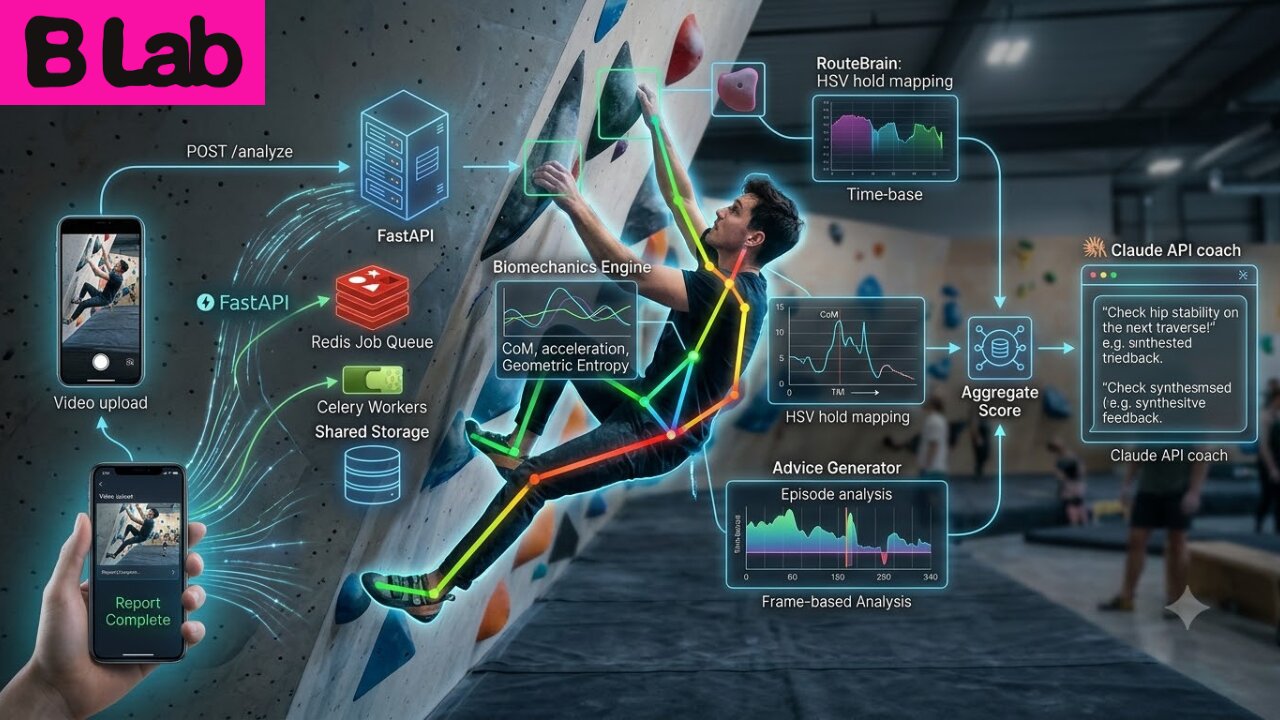
Where the engineering broke
The most severe limit came from the rigidity of the traffic-light system itself. In modern, high-difficulty bouldering, the classic rules of biomechanical stability don't hold absolute value. Climbers routinely — and deliberately — override standard efficiency guidelines: dynamic lunges, cut-loose moves, asymmetric loading are often the only physical way to solve a specific block. The system had no way to tell a genuine inefficiency from a deliberate, correct choice, and it would flag both in red. That was compounded by the lack of depth perception from a single camera, which made it impossible to calculate real foot pressure or how close the hips actually sat to the wall on volume-heavy routes.
The limits of the business idea
Alongside the engineering problems, the harder collision was with market reality — three obstacles in particular.
The validation trap. I assumed my personal obsession with technical improvement was a shared community need. Reading nicchia feedback on Reddit, where similar ideas had already surfaced, showed the opposite: most climbers actively resist bringing technology into a space they experience as disconnection, nature, and pure social contact. The problem I was solving simply wasn't felt as a problem by the people I was building for.
A niche that doesn't spend. Climbers and boulderers are historically reluctant to pay recurring fees for digital add-ons. A ~€15/month subscription model met real resistance from a target that doesn't want another recurring cost.
A market smaller than it felt. My gut estimate put the addressable market near a million practitioners. Official FASI (Italian Sport Climbing Federation) registration data — the real gatekeeper for regular gym access — put the real number closer to 200,000 climbers nationwide. Too small a niche to support a scalable model; break-even was mathematically out of reach in the medium term.
What I took from it
The project never reached a commercial launch, but building it was a genuine accelerator — on two very different levels.
Technical (hard skills)
- Vibe coding, for real. I learned to work with tools like Cursor and advanced language models to generate, refactor and fix code at a speed manual programming can't match.
- Full-stack ownership. A complete development flow, from a Python backend through version control on GitHub.
- Infrastructure and data. Serverless architecture and a relational database on Supabase for secure user data — including the waitlist — deployed via Netlify and Hostinger.
Strategic (soft & business skills)
- Fall in love with the problem, not the solution. The classic startup mistake, learned the hard way: building complex architecture before validating that the market actually feels the need. Projecting your own habits onto other people is the fastest route to failure.
- Research comes first. Listening channels like Reddit and competitor history would have saved months of development — the signals of a resistant, protective market were already there.
- Market numbers don't lie. ROI and TAM can't be built on intuition. The real FASI registration data proved that excellent technology aimed at too small a market stays exactly that: a style exercise.